




 International
  Argentina
  Australia
  Austria
  Belgium
  Brazil
  Canada
  Chile
Chile  Czechia
  Denmark
  Estonia
  Finland
  France
  Germany
  Greece
  Hungary
  India
India  Indonesia
  Ireland
  Israel
  Italy
Italy  Japan
Japan  Netherlands
  New Zealand
  Nigeria
  Norway
  Malaysia
  Mexico
  Peru
Peru  Philippines
  Poland
  Qatar
Qatar  Romania
  Russia
  Slovakia
  Slovenia
  South Africa
  South Korea
  Spain
Spain  Sweden
  Switzerland
  Thailand
  Turkey
  Vietnam
  UAE
UAE  United Kingdom
  USA
USA - Casino News
- Game Providers
- USA News
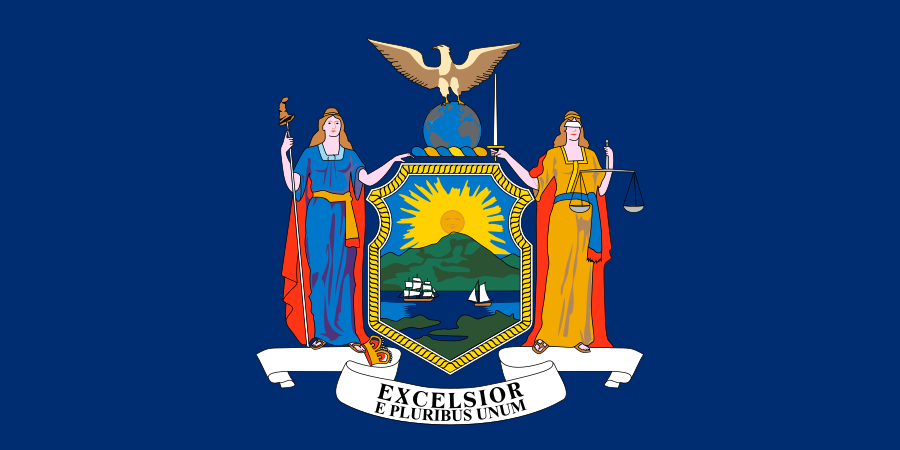
New York iGaming Bills Return for Fifth Year


NYC developments
For the fifth consecutive year, Senator Joseph Addabbo Jr. has filed legislation to legalise online casino gaming in New York — and for the first time, the structural barriers that previously blocked progress have quietly shifted in his favour.
As New York lawmakers returned for the 2026 legislative session, legalising real-money online casino gaming was once again on the agenda. Senator Addabbo, a Democrat from Queens and chair of the Senate Racing, Gaming, and Wagering Committee, reintroduced Senate Bill S2614 on January 7, alongside a companion Assembly Bill A6027 sponsored by Assemblywoman Carrie Woerner. The bills propose a comprehensive framework for regulated iGaming in the Empire State — and this year, two long-standing roadblocks have been removed, even as familiar opposition from labour unions and public health advocates persists.
What the bills actually propose
The Addabbo-Woerner legislation sets out one of the more detailed iGaming frameworks introduced in any US state this cycle. Eligibility would extend to commercial casinos, video lottery terminal facilities, tribal operators through compact agreements, and existing mobile sports betting licensees. Permitted games would include slots, table games, live dealer products, online poker, and internet lottery. Each eligible operator would be granted one branded online casino skin, with licensing fees set at $2 million per operator. Companies seeking to act as independent platform contractors would face a separate $10 million licensing requirement.
The proposed tax rate of 30.5% on gross gaming revenue is significantly lower than New York’s 51% levy on sports betting — the highest in the United States — but would still rank among the steeper iGaming tax rates contemplated nationally. Promotional credits and bonus bets would not be deductible from taxable revenue prior to taxation. Addabbo’s bill projects approximately $1 billion in annual state tax revenue on conservative market estimates, along with around $150 million in one-time licensing fees in the first year of operation.
A third measure, Assembly Bill A5922, also sponsored by Woerner, takes a similar approach to legalisation but places stronger emphasis on consumer protections and responsible gambling requirements. Woerner has also filed separate legislation that would classify certain online poker games as games of skill — a narrower, fallback pathway that would sidestep the broader iGaming debate if the main bills stall.
- All three online casino bills remain in their respective Racing and Wagering committees as of early March 2026, awaiting agreement on tax rates, licensing terms, and responsible gambling provisions before any floor vote.
- The legislation earmarks no less than $25 million annually for a programme covering employee training, responsible gaming education, and health initiatives — a direct concession to labour union concerns.
- Even in an optimistic scenario where the bills pass before the session ends in June, a realistic launch timeline for live platforms would be early-to-mid 2027, following regulatory rulemaking and licensing by the New York State Gaming Commission.
Why this year is structurally different
For years, Addabbo’s iGaming bills faced a two-headed obstacle: the unresolved question of downstate casino licences, and an active grey market of sweepstakes gambling platforms operating openly to New York residents. Both obstacles are now gone. In late 2025, the state finalised its long-delayed process of selecting downstate casino operators, awarding licences to Bally’s Bronx, Resorts World New York City, and Metropolitan Park — backed by Hard Rock International and Mets owner Steve Cohen. Governor Hochul and other lawmakers had previously signalled that no additional gaming expansion would be considered until the downstate licensing process concluded. That condition has now been met.
A precursor to the iGaming bills was the sweepstakes casino ban signed into law by Governor Hochul in December 2025, which outlawed dual-currency casino-style games and effectively removed sweepstakes operators from the New York market. Addabbo has described the ban as a deliberate step toward regulated iGaming — demonstrating that the governor is willing to close unregulated channels in anticipation of a licensed alternative. Hochul has not formally endorsed iGaming legalisation, but her approval of the sweepstakes ban has led observers to suggest she may support a regulated, consumer-protected framework to prevent residents from continuing to seek unregulated options.
The regional competitive context has also become harder to ignore. New Jersey’s total gaming revenue reached a record $6.98 billion in 2025, with online casino revenue alone hitting nearly $2.91 billion — a 22% year-on-year increase and the first time in the state’s history that internet gaming revenue surpassed that of land-based casinos. “For every year we don’t do it, we lose about a billion dollars to New Jersey, Connecticut, Pennsylvania, and the illegal market,” Addabbo told iGaming Business.
Opposition that hasn’t gone away
“It took five years to pass legislation in Michigan, and many of these states, it’s only been two, three years. It takes time to educate other lawmakers.”
— Brandt Iden, VP of Government Affairs, Fanatics Betting & Gaming, speaking to iGaming Business
The most durable opposition to New York iGaming has come not from moral objectors but from organised labour. The Hotel and Gaming Trades Council, an influential union representing thousands of workers at brick-and-mortar casinos, has historically opposed iGaming on the grounds that digital options will cannibalise physical casino revenues and threaten jobs. The 2026 bills attempt to directly address this by requiring applicants to demonstrate labour peace agreements as part of the licensing process, alongside the $25 million workforce development fund. Whether that concession is sufficient to shift the HTC’s position remains the central political question of the current session.
Public health advocates have raised separate concerns. Problem gambling rates in New York have risen since the introduction of mobile sports betting, and critics argue that extending easy digital access to casino-style games would compound existing harms. Addabbo has countered that the regulated environment — with identity verification, wagering controls, and mandatory self-exclusion tools — offers more protection than the offshore and illegal platforms where New Yorkers are already gambling today. “When I advocate for iGaming, yes, it’s sustainable revenue. But it’s about protecting the New Yorker doing it in an unsafe manner,” he said.
There is also a broader structural concern about the tax rate itself. At 30.5%, New York’s proposed levy is materially higher than the rates in Michigan (20–28%) and Connecticut (18%), and operators have privately flagged that a rate at this level could compress margins to the point where the market struggles to attract competitive offerings. Promotional credits and bonuses would also be non-deductible from taxable revenue — an additional constraint that operators in lower-tax states do not face. The legislature’s willingness to moderate the rate in negotiation will partly determine how many operators view the market as commercially viable at launch.
The national stakes of New York moving
At present, seven states have active legal online casino markets. Maine is set to become the eighth following recent legislative action, but New York would be in a category of its own — a market so large that its regulatory model would almost certainly influence how other states approach iGaming policy in the years ahead. New York would quickly become the national leader in online casino gaming should legalisation proceed, generating hundreds of millions in annual tax revenue and establishing a licensing and oversight framework that smaller states could reference as a template.
The prediction markets question adds a further wrinkle to New York’s digital gambling landscape. Addabbo has flagged platforms such as Kalshi as a growing revenue threat to the state’s licensed sportsbook operators, who pay a 51% tax rate, while prediction market platforms currently pay nothing. Rather than pursuing another ban, the senator has suggested regulation as the appropriate response — a framing that mirrors his broader argument on iGaming and indicates a wider shift toward bringing unregulated digital wagering into state-supervised structures.
For New York residents, the practical implications of the current legislative moment are straightforward: online casino gaming remains unavailable through any legal, regulated domestic channel, and the offshore market continues to absorb demand that a licensed framework would redirect into state tax revenues. Should the 2026 session produce a bill that clears both chambers and receives the governor’s signature before the June deadline, live regulated platforms are still unlikely to appear before early 2027 — but the path from Albany to a working market has never, in five years of attempts, been more credibly within reach. The question of whether this session finally converts momentum into legislation will be answered in the coming months, and the entire US iGaming industry will be watching.
The Hottest USA Casinos 2025
welcome bonus
200%/€877 + 100 Free Spins
- Low minimum deposit of €10.
- Dedicated Android app and iOS PWA.
- Free spins and no-deposit bonus offers.

Restricted in US
welcome bonus
200%/€500
- Offers a varied range of slots and casino titles to suit different playing preferences.
- Features games with the potential for exciting jackpot prizes and rewarding wins.
- Provides a straightforward online casino environment that makes browsing and accessing games simple.
Restricted in US
welcome bonus
200%/€500
- Offers a varied range of slots and casino titles to suit different playing preferences.
- Features games with the potential for exciting jackpot prizes and rewarding wins.
- Provides a straightforward online casino environment that makes browsing and accessing games simple.
welcome bonus
150%/500€ + 200 Free Spins
- A varied casino lobby with plenty of slots and popular casino titles.
- Supports cards, Open Banking, e-wallets, mobile payments and crypto.
- Customer assistance is available around the clock for account and payment queries.
welcome bonus
475% up to 490 USD
- A Huge Game Collection with over 3,500 Game Titles.
- Exclusive Tournaments Section.
- Generous Welcome bonus.
Restricted in US
welcome bonus
100%/$3,000
- A Huge Game Collection with over 3,500 Game Titles.
- Exclusive Rocket Races Section.
- Generous Welcome bonus.
Restricted in US
welcome bonus
100%/€2,000 + 300 Free Spins
- A Huge Game Collection with over 14,000 Game Titles.
- Exclusive Tournaments Section.
- Generous Welcome bonus and Cashback.
Restricted in US
welcome bonus
100%/€500
- 8,000+ games from 60+ leading providers.
- Wager-free bonuses and weekly Free Spins.
- Wide range of secure payment methods.
Restricted in US
welcome bonus
400%/€2,200 + 350 Free Spins
- Extensive gaming library featuring over 9,000 titles from 70+ well-known European software providers.
- Fast withdrawals, with funds typically credited within 15–30 minutes after approval.
- Advanced VIP programme with five accessible loyalty levels and an additional invitation-only tier.
Restricted in US
welcome bonus
100%/€1,000 + 100 Free Spins
- Extensive gaming library featuring over 14,000 titles from 70+ well-known European software providers.
- Fast withdrawals, with funds typically credited within 15–30 minutes after approval.
- Advanced VIP programme with five accessible loyalty levels and an additional invitation-only tier.
Top 10 best casinos
$titl$ is RESTRICTED IN United States. Our Current Top Picks for United States are below: