





 International
  Argentina
  Australia
  Austria
  Belgium
  Brazil
  Canada
  Chile
Chile  Czechia
  Denmark
  Estonia
  Finland
  France
  Germany
  Greece
  Hungary
  India
India  Indonesia
  Ireland
  Israel
  Italy
Italy  Japan
Japan  Netherlands
  New Zealand
  Nigeria
  Norway
  Malaysia
  Mexico
  Peru
Peru  Philippines
  Poland
  Qatar
Qatar  Romania
  Russia
  Slovakia
  Slovenia
  South Africa
  South Korea
  Spain
Spain  Sweden
  Switzerland
  Thailand
  Turkey
  Vietnam
  UAE
UAE  United Kingdom
  USA
USA - Bonuses & Promotions
- Casino News
- Game Providers
- USA News
South Dakota Lawmakers Advance Online Wagering Bill


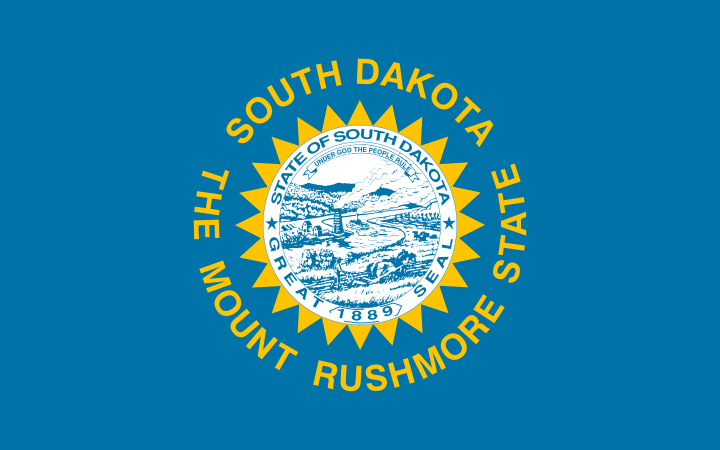
South Dakota lawmakers are moving forward with legislation designed to provide new financial support for the state’s remaining horse racing operations, as supporters warn that live racing faces continued decline without additional revenue sources.
The House voted 56–10 to pass House Bill 1058, which would authorize regulated online wagering on horse and dog racing. The bill now advances to the Senate, where lawmakers will decide whether to extend pari-mutuel betting into the digital marketplace under state oversight.
Backers of the proposal say the measure responds to long-standing funding challenges in an industry that has steadily contracted over time. Live horse racing in South Dakota has diminished to a single annual hub, with organizers struggling to offset rising costs and falling betting activity.
-
House Bill 1058 would allow regulated online pari-mutuel wagering on horse and dog racing to provide new funding for South Dakota’s last live racing hub in Fort Pierre.
-
Supporters argue that online wagering captures revenue currently lost to other states and helps sustain race purses and operational costs for local racing events.
-
The legislation does not expand gambling beyond racing, focusing on digital adaptation while providing state oversight and consumer protections.
Horse racing concentrated in Fort Pierre
Live horse racing in South Dakota is now limited to Fort Pierre, where the Verendrye Benevolent Association organizes the state’s only race meets. While the events continue, organizers say traditional wagering no longer produces enough revenue to sustain racing at earlier levels.
According to supporters of the bill, the decline reflects changes in how people place bets rather than waning interest in horse racing itself. As wagering has shifted online, revenue tied to physical tracks has dropped, leaving local operators with fewer options to fund purses and operating expenses. House Bill 1058 would allow the South Dakota Commission on Gaming to license and regulate online pari-mutuel wagering providers for horse and dog racing. Pari-mutuel wagering pools bets together, with payouts determined by the total amount wagered on each outcome.
The legislation is narrowly drafted. It does not authorize sports betting or online casino gambling, which remain prohibited under state law. Instead, it limits online wagering to bets directly connected to racing events. Supporters argue that the bill modernizes existing gambling laws without expanding them. Republican Rep. Mike Weisgram, the bill’s prime sponsor, described the proposal as a regulatory update that reflects how wagering already occurs.
“This bill does not create new gambling,” Weisgram told House members during floor debate. “It allows existing pari-mutuel wagering to occur online.” Weisgram and other supporters said South Dakota residents already place online horse racing bets through platforms licensed in other states. Because state law does not clearly regulate that activity, those wagers generate no revenue for South Dakota racing operations or the state itself.
By authorizing and regulating online pari-mutuel betting, supporters say the state could capture a portion of that activity rather than losing it to other jurisdictions. They compared the approach to South Dakota’s earlier efforts to apply sales tax rules to online commerce.
Industry support and financial pressure
Racing groups testified in favor of the bill, citing ongoing financial strain. Shane Kramme of the South Dakota Horsemen’s Association told lawmakers that the industry has faced declining revenues for decades and that online wagering offers one of the few viable paths forward.
Advocates said online betting would allow fans to place legal wagers without traveling to a physical track, potentially expanding the audience beyond Fort Pierre. Revenue from those wagers, they said, could help support race purses and cover operational costs. The South Dakota Commission on Gaming has approved race dates for October, but organizers have warned that financial constraints could limit the scale of the event. Without new funding sources, supporters said, live racing could be reduced further. The bill faced some resistance. Family Voice Action registered “soft opposition,” raising concerns about gambling expansion. Rep. Tina Mulally voted against the measure.
Supporters countered that a regulated system would provide clearer oversight and stronger consumer protections than unregulated online alternatives. Rep. Drew Peterson argued that transparency and state supervision were key advantages of bringing pari-mutuel wagering under formal regulation.
Despite the objections, the bill passed the House by a wide margin.
Senate decision ahead
House Bill 1058 now moves to the Senate, where lawmakers will determine whether South Dakota’s horse racing industry gains access to online wagering as a new revenue tool or continues operating under its current model. The outcome will be closely watched by racing advocates and policymakers in other states facing similar declines. For South Dakota, the decision could signal whether legislative adaptation is enough to preserve a shrinking but historic industry.
Top 10 best casinos
$titl$ is RESTRICTED IN United States. Our Current Top Picks for United States are below: