





 International
  Argentina
  Australia
  Austria
  Belgium
  Brazil
  Canada
  Chile
Chile  Czechia
  Denmark
  Estonia
  Finland
  France
  Germany
  Greece
  Hungary
  India
India  Indonesia
  Ireland
  Israel
  Italy
Italy  Japan
Japan  Netherlands
  New Zealand
  Nigeria
  Norway
  Malaysia
  Mexico
  Peru
Peru  Philippines
  Poland
  Qatar
Qatar  Romania
  Russia
  Slovakia
  Slovenia
  South Africa
  South Korea
  Spain
Spain  Sweden
  Switzerland
  Thailand
  Turkey
  Vietnam
  UAE
UAE  United Kingdom
  USA
USA - Bonuses & Promotions
- Casino News
- Game Providers
- USA News
Nevada lawmakers push to repeal 2026 gambling tax


Bipartisan effort to undo tax change
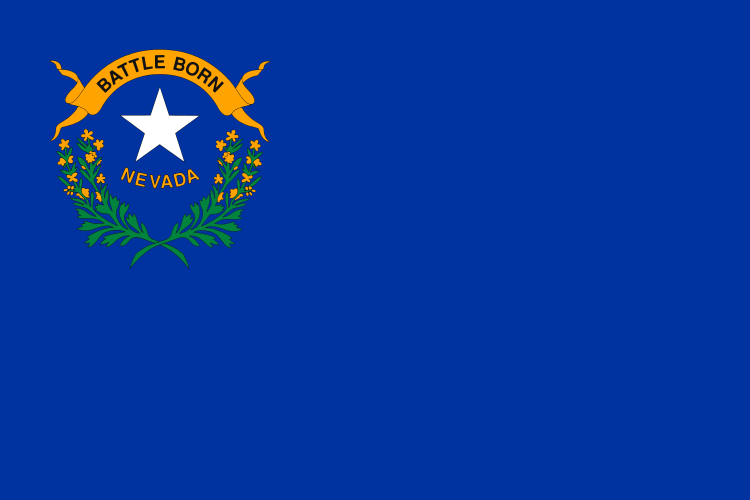
LAS VEGAS — Nevada’s congressional delegation and casino industry leaders are mounting a bipartisan push to reverse a federal tax change set to take effect in 2026 that would limit how much gamblers can deduct in losses, warning it could ripple through the state’s tourism-driven economy.
The change was enacted as part of the One Big Beautiful Bill Act, signed into law by President Donald Trump in July 2025. Beginning Jan. 1, 2026, gamblers will be able to deduct only 90% of their gambling losses, down from the longstanding rule that allowed deductions equal to 100% of winnings.
Lawmakers and industry representatives argue the provision would force gamblers to pay taxes on income they did not actually earn — a phenomenon they describe as “phantom income.” They say the policy could discourage wagering, reduce tourism and ultimately lead to job losses in Nevada, where casinos and hospitality remain central economic pillars.
A long-standing rule, quietly altered





Rep. Dina Titus, a Democrat who represents Las Vegas, has introduced the FAIR BET Act to restore full deductibility of gambling losses. Titus said the response to the proposal has been unusually broad, reflecting how widely the change would be felt. In the Senate, Democratic Sens. Catherine Cortez Masto and Jacky Rosen are leading a bipartisan effort through the FULL HOUSE Act. Cortez Masto’s office has warned the provision could cost Nevada jobs and weaken its tourism economy. Both senators have also pointed to the way the language was added late in the tax bill process, limiting debate and scrutiny.
Republican lawmakers from Nevada have also voiced concerns. Rep. Mark Amodei said he has been working with colleagues from both parties to find a path forward, describing the issue as one with clear bipartisan implications. Amodei said House leaders have suggested the matter could be addressed through the 2026 appropriations process. He has also discussed the issue with House Ways and Means Committee Chair Jason Smith, who has indicated there is bipartisan support for restoring full deductions.
Despite those discussions, no firm timeline has emerged, leaving gamblers and casino operators uncertain about whether Congress will act before or after the rule takes effect.
Industry warns of economic fallout
Casino executives and professional gamblers say the tax change could have immediate and measurable consequences. Poker Hall of Famer Erik Seidel has said the new rules have forced him to reconsider his future in the game, arguing that continued professional play may no longer be financially viable. He warned that fewer players could enter tournaments, potentially leading to fewer events and job losses for dealers and support staff.
Other professional gamblers have echoed those concerns, with some saying they may scale back their activity or move play outside the United States. Casino executives say the uncertainty is already affecting customer behavior. Derek Stevens, CEO of Circa Resort & Casino, said some gamblers with long-term travel plans are cutting back on future spending in anticipation of the tax change.
Stevens warned the rule could dampen wagering around major events such as the Super Bowl and the NCAA men’s basketball tournament in March. He also said some slot players may wager less because of the added tax burden.
Industry officials fear the impact could extend beyond casino floors to hotels, restaurants and other tourism-related businesses. They have also raised concerns that gamblers could shift play to offshore websites or casinos in Canada, further reducing U.S. tax revenue. Many lawmakers say they are frustrated that the gambling provision has drawn little public ownership within Congress. Few members have acknowledged adding it, and it is widely reported to have been inserted late during Senate negotiations on the broader tax package.
That timing made it difficult to challenge before the bill’s passage. Some lawmakers have also been reluctant to reopen a signature tax law backed by the president, even as bipartisan support for repealing the gambling provision has grown. Budget rules and procedural hurdles have further slowed progress.
This policy would force gamblers to pay taxes on money they never actually earned, creating phantom income that could harm Nevada’s economy and cost jobs.
Uncertainty as 2026 approaches
The deduction limit applies to gambling wins and losses earned starting Jan. 1, 2026. While the legal change is still months away, industry leaders say economic effects could emerge sooner as gamblers adjust travel plans and spending habits. Nevada lawmakers, casino operators and trade groups continue lobbying Congress for a fix. For now, whether lawmakers can agree on a solution before the new rule takes effect remains an open question, leaving gamblers and businesses facing continued uncertainty.
The Hottest USA Casinos 2025

 Rated 79.82/100%
welcome bonus
Get up to $100,000.00 in bonuses for your first 4 deposits.
50x wagering (Deposit & Bonus)
Rated 92.95/100%welcome bonus
200% up to €1,000 Cash Bonus
30x wagering (Deposit & Bonus)
Rated 78.46/100%welcome bonus
UP TO 1500€ AND 300 FS!
20x wagering (Deposit & Bonus)
Rated 79.73/100%welcome bonus
Up to 3 000 € + 600 FS
30x wagering (Deposit & Bonus)
Rated 92.97/100%welcome bonus
€2,000 and 200 Free Spins
40x wagering (Deposit & Bonus)
Rated 79.31/100%welcome bonus
300%/€2000 + 300 Free Spins
35x wagering (Deposit & Bonus)
 Rated 92.40/100%
welcome bonus
100% First Deposit Bonus – up to $1,000
40x wagering (Deposit & Bonus)
Rated 92.95/100%welcome bonus
100% Welcome Bonus
20x wagering (Deposit & Bonus)
https://m.hv119.fun/en/terms-and-conditions
Rated 92.97/100%welcome bonus
20 000 ₺ + 525 Free Spins
40x wagering (Deposit & Bonus)
Rated 92.96/100%welcome bonus
200%/€2500 + 300 Free Spins
35x wagering (Deposit & Bonus)
Top 10 best casinos
$titl$ is RESTRICTED IN United States. Our Current Top Picks for United States are below: