




 International
  Argentina
  Australia
  Austria
  Belgium
  Brazil
  Canada
  Chile
Chile  Czechia
  Denmark
  Estonia
  Finland
  France
  Germany
  Greece
  Hungary
  India
India  Indonesia
  Ireland
  Israel
  Italy
Italy  Japan
Japan  Netherlands
  New Zealand
  Nigeria
  Norway
  Malaysia
  Mexico
  Peru
Peru  Philippines
  Poland
  Qatar
Qatar  Romania
  Russia
  Slovakia
  Slovenia
  South Africa
  South Korea
  Spain
Spain  Sweden
  Switzerland
  Thailand
  Turkey
  Vietnam
  UAE
UAE  United Kingdom
  USA
USA - Bonuses & Promotions
- Casino News
- Game Providers
- USA News
Arizona Revokes DFS Licence Over Prediction Markets


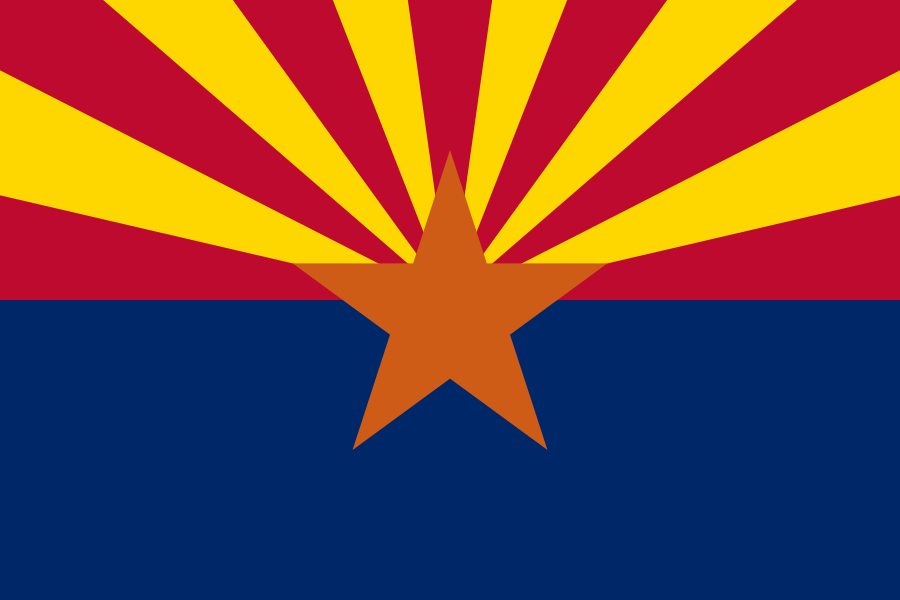
Arizona regulators have taken what appears to be the first step by a US state to revoke a daily fantasy sports (DFS) licence specifically over a company’s involvement in prediction market activities, a move that could carry broader implications for gaming regulation nationwide ahead of 2026.
The action against Underdog emerged as a central topic at last week’s National Conference of Legislators from Gaming States (NCLGS) meeting in San Juan, Puerto Rico, where prediction markets dominated panel discussions and informal debate. Arizona’s decision, outlined publicly by state officials during the conference, drew attention from regulators across the country who are grappling with how to classify and oversee sports event contracts.
| State | Operator | Action | Reason |
|---|---|---|---|
| Arizona | Underdog | DFS Licence Revoked | Prediction Market Partnership with Crypto.com |
| Louisiana | N/A | Advisory Issued | Prediction Markets Restricted to Licensed Sportsbooks |
Arizona Targets Underdog Over Crypto.com Partnership





“This was a very clear case that the operator was offering something in Arizona that we consider to be an illegal product,” said Chris Kotterman, a policy adviser in the Arizona governor’s office, during an NCLGS panel discussion. Kotterman added that Underdog’s partnership with Crypto.com “affects their suitability” as a licensee and required a firm regulatory response.
First Revocation Linked Directly to Prediction Markets
The violation notice marks the first known instance of a state regulator pulling a DFS licence due specifically to prediction market activity. The 16-page filing includes Arizona’s earlier cease-and-desist orders, correspondence with Underdog, and the company’s November response to regulators. In the notice, the Department of Gaming stated that Underdog was “aiding and abetting” Crypto.com’s illegal conduct in Arizona and providing a “facade of legitimacy” for its operations. Regulators further concluded that the relationship posed a “threat to the public interest.”
The decision sparked immediate debate within the gaming industry, particularly around whether partnerships with prediction market platforms could expose otherwise licensed operators to regulatory risk, even when such products are not offered within a given state. Arizona currently licenses 14 sportsbook operators, including DraftKings, FanDuel, and Fanatics. FanDuel and Fanatics offer sports event contracts through prediction market platforms in states outside Arizona, while DraftKings has reportedly signaled plans to launch its own prediction market product in the first half of 2026.
Following the panel, Kotterman addressed concerns about extraterritorial conduct, noting that FanDuel’s partnership with CME Group differs from the Underdog situation because the platform is not available in Arizona. He declined to say whether the same standards applied to DFS operators would be extended to sports betting licensees, limiting his remarks to the Underdog case. That uncertainty has heightened concerns among operators about how state regulators may factor out-of-state activity into suitability determinations.
Other States Watching Closely
The issue has resonated beyond Arizona. The Louisiana Gaming Control Board issued an advisory notice earlier this month stating that sports event contracts can only be offered in the state by licensed sportsbooks that meet all wagering requirements. Asked whether violations in other states could affect licensing decisions in Louisiana, board chairman Christopher Hebert declined to comment, citing the matter as pending.
Legal experts have warned that states face limits when considering out-of-state conduct. Andrew Kim, a gaming law specialist with Goodwin, wrote that while regulators have broad discretion in licensing, they risk “dangerous waters” if they attempt to police activities occurring in other jurisdictions. Tribal gaming leaders also weighed in. Victor Rocha, chairman of the Indian Gaming Association conference, dismissed criticism of Arizona’s action, arguing that the response to prediction markets has been predictable given their perceived threat to established gaming frameworks.
This was a very clear case that the operator was offering something in Arizona that we consider to be an illegal product.
Wider Impact
Underdog has said it will “vigorously defend” itself, arguing that Arizona is attempting to override federal law governing prediction markets. The company maintains that its prediction market products are not available to Arizona customers and that its partnership with Crypto.com does not involve DFS operations. An appeal is planned.
Wall Street analysts have suggested the stakes extend beyond a single operator. Citizens analyst Jordan Bender wrote that the action against Underdog could signal further enforcement, calling it “only a matter of time” before Arizona examines other licensees. Bender and his colleagues also said the move could set a precedent for other states with legal sports betting. As prediction markets continue to blur the line between financial products and gambling, Arizona’s decision may serve as an early test case for how aggressively states are willing to enforce suitability standards—particularly as more operators eye launches ahead of 2026.
Top 10 best casinos
$titl$ is RESTRICTED IN United States. Our Current Top Picks for United States are below: