






 International
  Argentina
  Australia
  Austria
  Belgium
  Brazil
  Canada
  Chile
Chile  Czechia
  Denmark
  Estonia
  Finland
  France
  Germany
  Greece
  Hungary
  India
India  Indonesia
  Ireland
  Israel
  Italy
Italy  Japan
Japan  Netherlands
  New Zealand
  Nigeria
  Norway
  Malaysia
  Mexico
  Peru
Peru  Philippines
  Poland
  Qatar
Qatar  Romania
  Russia
  Slovakia
  Slovenia
  South Africa
  South Korea
  Spain
Spain  Sweden
  Switzerland
  Thailand
  Turkey
  Vietnam
  UAE
UAE  United Kingdom
  USA
USA - Casino News
- Crypto
- Industry News
A Complaint, a Crypto Gap, and a Wider Question for UK Banks


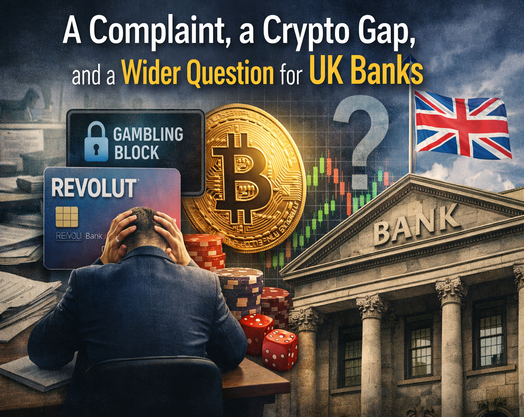
A Complaint, a Crypto Gap, and a Wider Question for UK Banks

A recent decision by the UK Financial Ombudsman Service has brought renewed attention to the limits of existing banking safeguards designed to reduce gambling-related harm. While gambling block tools have become a standard feature across much of the UK banking sector, the ruling suggests that these measures may not always meet regulatory expectations, particularly when customers explicitly ask for stronger intervention.
The case involved a customer, identified as Mr H, who approached digital bank Revolut seeking help with a gambling addiction. His requests were direct and repeated. He asked for his account to be closed or for his access to cryptocurrency services to be restricted, explaining that he was struggling to control his gambling behaviour. Revolut responded by pointing him toward tools already available within its app, including a gambling block and the option to hide cryptocurrency features.
 The Financial Ombudsman Service concluded that this response did not adequately reflect the seriousness of the situation. While the bank had technically offered protective tools, the ombudsman found that it failed to engage with what the customer was actually asking for. Mr H had not been seeking information about optional features; he had been asking for decisive action that would remove his access to certain financial services altogether.
Timing played a significant role in the decision. Mr H first contacted Revolut on May 27, 2025. According to the ombudsman’s findings, meaningful support was not provided until July 24, after the case had been escalated internally. During that period, the customer was redirected between teams that were unable to offer the level of assistance he requested. The delay, combined with the lack of effective action, led the ombudsman to award £400 in compensation.
 In its reasoning, the Financial Ombudsman Service questioned why Revolut did not consider closing the account, given its authority to do so. The ruling criticised the bank for relying on standardised responses rather than taking a broader view of the options available. The ombudsman noted that Mr H’s vulnerability had been clearly communicated, but that the bank’s approach did not reflect an effort to understand or address the underlying issue fully.
The case also exposed a practical gap in how gambling-related controls operate within modern banking systems. Gambling block tools typically prevent card payments to gambling operators, particularly those licensed in the UK. However, Mr H’s gambling activity involved cryptocurrency transactions, which fell outside the scope of Revolut’s block. As a result, the safeguard had little effect on his behaviour.
 This aspect of the case has wider implications. While UK-licensed gambling operators are prohibited from accepting cryptocurrency, customers can still use digital assets to access gambling services operating outside the UK regulatory framework. The ombudsman’s decision suggests that banks cannot rely solely on existing regulatory boundaries when assessing customer risk, especially when customers themselves highlight the problem.
Another point raised by the ruling concerns how easily gambling blocks can be reversed. The Financial Ombudsman Service observed that these tools are usually designed for flexibility, allowing customers to switch them on or off with minimal effort. While this approach may suit users seeking temporary controls, the ombudsman questioned whether it is appropriate when a customer explicitly asks for restrictions that are harder to undo. The decision implies that banks should consider offering more durable measures when requested.
 Following the ruling, the Financial Ombudsman Service encouraged other customers to come forward if they believe their bank failed to provide adequate protection from gambling harm. It emphasised that complaints are assessed individually and that the service is intended to be accessible and impartial. Where shortcomings are identified, firms are expected to take corrective action promptly.
The case has attracted attention across the banking sector because it touches on practices that are now widespread. Digital banks such as Monzo and Starling Bank were among the first to introduce gambling blocks, and most major high-street banks followed in the early 2020s. These tools have often been presented as evidence that banks are taking gambling harm seriously. The ombudsman’s findings suggest that their presence alone may no longer be sufficient.
Top Online Casinos On Our Land
10 Recommended Online Brands On CasinoLandia That Will Enhance Your Gaming Experience
No results were found!