





 International
  Argentina
  Australia
  Austria
  Belgium
  Brazil
  Canada
  Chile
Chile  Czechia
  Denmark
  Estonia
  Finland
  France
  Germany
  Greece
  Hungary
  India
India  Indonesia
  Ireland
  Israel
  Italy
Italy  Japan
Japan  Netherlands
  New Zealand
  Nigeria
  Norway
  Malaysia
  Mexico
  Peru
Peru  Philippines
  Poland
  Qatar
Qatar  Romania
  Russia
  Slovakia
  Slovenia
  South Africa
  South Korea
  Spain
Spain  Sweden
  Switzerland
  Thailand
  Turkey
  Vietnam
  UAE
UAE  United Kingdom
  USA
USA - Casino News
- Industry News
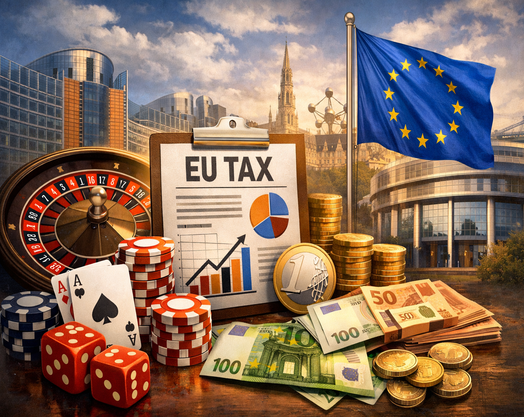
The Emerging Case for an EU Online Gambling Levy


The Emerging Case for an EU Online Gambling Levy
 A new fiscal idea is circulating within the European Parliament, placing the online gambling sector at the centre of a broader conversation about how the European Union funds its long-term priorities. The proposal does not yet exist in legislative form, nor has it been formally tabled as a draft directive. Still, the concept of a harmonised EU-level levy on online betting and gaming has gained political visibility and is beginning to draw attention across regulatory and industry circles.
Victor Negrescu, Vice-President of the European Parliament, has publicly supported the introduction of a coordinated tax applied across all Member States. His argument is framed around the EU’s structural budgetary constraints. As policy demands expand in areas such as education, youth development, and social resilience, the Union continues to rely largely on national contributions and a limited set of its own resources. In this context, the online gambling sector is presented as a potential contributor to a more autonomous EU revenue base.
 The core idea is straightforward: a fixed levy, potentially as low as 1%, applied uniformly to online gambling operators across the bloc. According to estimates cited in parliamentary discussions, the digital betting and gaming sector generated approximately €130 billion in revenue in 2022. With continued annual growth of around 5 per cent, total revenues may now be approaching €200 billion. Even a marginal EU-level charge applied to such figures would represent a notable addition to the Union’s financial resources.
Supporters of the proposal emphasise that the measure would sit alongside existing national gambling taxes rather than replace them. In practical terms, this would mean operators continuing to meet domestic fiscal obligations while also contributing to an EU-wide levy. Revenues collected at the European level would be directed towards defined priorities, including education funding, skills training, prevention programmes, and mental health initiatives. By linking the proposal to socially oriented expenditure, advocates seek to align fiscal reform with policy areas that enjoy broad political support.
 The debate, however, unfolds against a complex regulatory backdrop. Gambling taxation remains firmly under the authority of individual Member States. Unlike the value-added tax, which has been partially harmonised across the Union, gambling levies vary considerably. In some jurisdictions, taxes on gross gambling revenue stand at around five per cent; in others, they approach or exceed forty per cent. These differences reflect national regulatory philosophies, fiscal strategies, and varying assessments of how to balance state revenue with market sustainability.
Recent policy shifts illustrate the diversity of approaches. France and Sweden have raised gambling taxes to address budgetary and regulatory concerns. Estonia, by contrast, moved to reduce its gambling tax after a legislative error temporarily removed certain levies altogether. Such divergence underscores the absence of a unified framework and explains why calls for greater coordination periodically resurface.
 Critics of the current system argue that uneven tax rates can distort the internal market. Physical borders do not constrain digital operators as land-based businesses are. As a result, companies may choose to base operations in jurisdictions with lower tax burdens while targeting consumers across multiple Member States. A harmonised EU levy, supporters contend, could mitigate incentives for regulatory arbitrage and create a more consistent fiscal baseline.
Yet the proposal raises fundamental questions about sovereignty and institutional authority. The European Parliament does not possess independent taxation powers. Any move to introduce an EU-level gambling tax would require unanimous approval from all 27 Member States. This threshold presents a significant political hurdle. Countries that have cultivated competitive tax regimes or developed substantial online gambling industries may resist a measure perceived as reducing their fiscal flexibility.
Best Online Casinos
10 Recommended Online Brands On CasinoLandia That Will Enhance Your Gaming Experience
No results were found!