





 International
  Argentina
  Australia
  Austria
  Belgium
  Brazil
  Canada
  Chile
Chile  Czechia
  Denmark
  Estonia
  Finland
  France
  Germany
  Greece
  Hungary
  India
India  Indonesia
  Ireland
  Israel
  Italy
Italy  Japan
Japan  Netherlands
  New Zealand
  Nigeria
  Norway
  Malaysia
  Mexico
  Peru
Peru  Philippines
  Poland
  Qatar
Qatar  Romania
  Russia
  Slovakia
  Slovenia
  South Africa
  South Korea
  Spain
Spain  Sweden
  Switzerland
  Thailand
  Turkey
  Vietnam
  UAE
UAE  United Kingdom
  USA
USA - Big Wins/Jackpots
- Game Providers
- Media Partners
- New Slots
- Tournaments
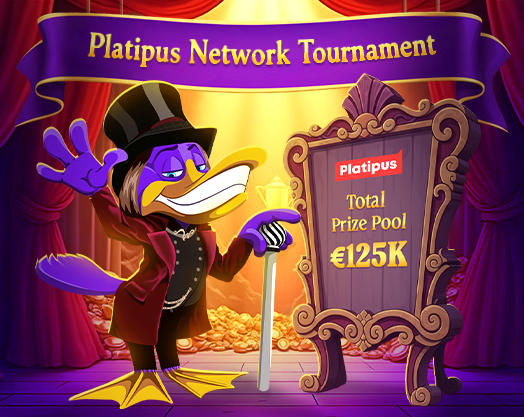
Some Heat On The Reels: The Platipus Network Tournament


Some Heat On The Reels: The Platipus Network Tournament



Network tournaments have gradually shifted from occasional promotional instruments to recurring engagement mechanisms embedded in casino platforms. As competition between operators intensifies and regulatory frameworks continue to shape incentive design, tournaments are increasingly evaluated through an operational lens rather than a purely marketing one. Within this context, the Platipus Network Tournament Series scheduled for 2026 provides a useful reference point for assessing how far tournament design has evolved and where it now exceeds common market practices.
Rather than relying on a single high-impact event, Platipus distributes its €125,000 prize pool across five tournament stages, each valued at €25,000. This decision reflects a broader industry trend toward continuity rather than intensity. For operators, recurring tournament stages offer predictable engagement cycles and reduce dependence on short-term activity spikes that are difficult to sustain or measure effectively.
 The calendar-based structure also allows casinos to integrate the tournament into broader promotional planning without displacing other campaigns. This type of scheduling flexibility is increasingly valued in an environment where promotional overlap and player fatigue have become tangible risks.
One of the defining characteristics of the Platipus Network Tournament is its decision to reward 150 leaderboard positions per stage. In many comparable network tournaments, prize pools of similar size are distributed across 50 to 100 positions, often with a disproportionate share allocated to the top five or ten players.
By extending rewards deeper into the leaderboard, Platipus shifts the competitive dynamic. Players are less likely to disengage early after falling behind the top tier, as the probability of reaching a paid position remains realistic for a larger portion of the participant base. This structure supports longer participation windows and reduces the perception that tournaments are relevant only to a narrow group of high-activity users.
 From an operator's perspective, this broader engagement profile aligns more closely with retention-focused KPIs than with short-term monetisation metrics alone. It encourages repeated sessions across the tournament period rather than isolated bursts of play.
The tournament's scoring system combines multipliers and absolute wins, converting both into points calculated in euros. This hybrid approach differs from the turnover-based models that still dominate parts of the market. Turnover-only systems tend to incentivise volume without regard to outcome, while win-only systems can overly reward rare, high-variance events.
By blending these elements, the Platipus model introduces balance. Players are rewarded for meaningful wins, but those wins are contextualised through multipliers rather than raw stake escalation. This reduces the structural advantage of aggressive wagering strategies and creates a competitive environment where different play styles can coexist.
 For operators operating under increasingly strict responsible gambling expectations, this type of scoring logic is not incidental. It reflects a design philosophy that encourages participation without structurally pushing players toward excessive risk-taking.
The minimum bet requirement of €0.20 per spin places the Platipus Network Tournament at the accessible end of market standards. While low entry thresholds are common, they are not always paired with prize structures that preserve perceived value. In this case, accessibility does not dilute competition, as leaderboard progression remains tied to performance rather than mere participation.
This design allows casual players to engage organically while still leaving room for more active users to compete meaningfully. Importantly, participation does not require a separate opt-in beyond wagering on the designated tournament games, reducing friction and integrating competition naturally into gameplay.
 Each tournament stage is anchored to a specific Platipus title, including Santa's Bag, Pirate's Legacy, Catch the Leprechaun, Jackpot Lab, and Pirate's Map, supported by rotating feature games. This curated approach contrasts with open-catalog tournaments that span dozens of titles.
Controlled game selection serves several analytical purposes. It concentrates traffic on specific products, improves the visibility of individual titles, and allows operators to assess tournament-driven performance with greater precision. Rather than diffusing engagement across an entire portfolio, the tournament becomes a focused testing environment for both content and mechanics.
The table below outlines how the Platipus Network Tournament compares structurally with typical network tournaments currently offered in the market.
| Element | Platipus Network Tournament | Typical market approach |
|---|---|---|
| Total prize pool | €125,000 across five stages | €20,000–€100,000, often concentrated |
| Event frequency | Recurring stages throughout the year | One-off or limited campaigns |
| Paid leaderboard positions | 150 per stage | 50–100 |
| Scoring model | Hybrid wins and multipliers | Turnover or win-based |
| Minimum bet | €0.20 | €0.20–€0.50 |
| Cost predictability for operators | High | Medium |
What distinguishes the Platipus model is not any single parameter, but the consistency across all of them. Each element aligns with current best practices, yet their combined effect produces a tournament structure that sits clearly above the market median.
 From an operational standpoint, the Platipus Network Tournament offers high predictability. Costs are fixed in advance, integration relies on Platipus's in-house tournament tool, and leaderboard mechanics are automated and transparent. For operators already integrated with the provider, implementation requires minimal additional development effort.
Equally important is the tournament's ability to generate usable data. Because stages recur throughout the year and focus on defined game sets, operators can observe trends in engagement, session length, and repeat participation with greater clarity than in isolated campaigns.
 The Platipus Network Tournament does not seek to redefine what a network tournament is. Instead, it refines how such tournaments are structured, aligning prize distribution, scoring mechanics, accessibility, and scheduling into a coherent system.
When evaluated against prevailing market standards, the tournament stands above them not through excess, but through design discipline. For online casinos considering participation, its value lies in predictability, engagement depth, and operational clarity. In an industry where marginal improvements increasingly determine competitive position, the Platipus Network Tournament represents a structurally sound and strategically relevant benchmark.
Platipus Has Prepared Some Fantastic Surprises For You
Check out the most exciting 10 slots available at out top-recommended Platipus Casinos