





 International
  Argentina
  Australia
  Austria
  Belgium
  Brazil
  Canada
  Chile
Chile  Czechia
  Denmark
  Estonia
  Finland
  France
  Germany
  Greece
  Hungary
  India
India  Indonesia
  Ireland
  Israel
  Italy
Italy  Japan
Japan  Netherlands
  New Zealand
  Nigeria
  Norway
  Malaysia
  Mexico
  Peru
Peru  Philippines
  Poland
  Qatar
Qatar  Romania
  Russia
  Slovakia
  Slovenia
  South Africa
  South Korea
  Spain
Spain  Sweden
  Switzerland
  Thailand
  Turkey
  Vietnam
  UAE
UAE  United Kingdom
  USA
USA - Casino News
- Industry News
Russia Reconsiders Its Online Casino Ban


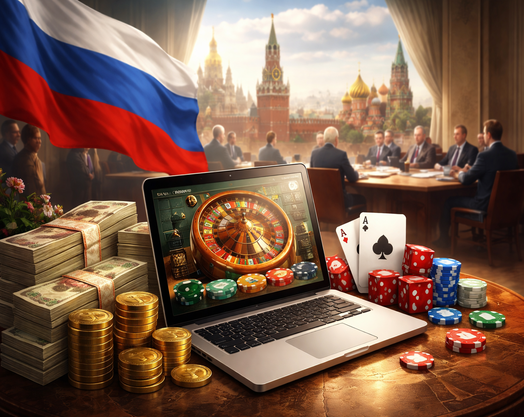
Russia Reconsiders Its Online Casino Ban
 Russia’s long-standing ban on online casinos is facing renewed scrutiny as economic pressure pushes policymakers to reconsider previously settled positions. A proposal put forward by Finance Minister Anton Siluanov suggests that legalising and regulating online casino gambling could provide the state with an additional revenue stream at a time when the federal budget is under sustained strain. The idea, presented to President Vladimir Putin and reported by Russian media, has reopened a debate that extends beyond public finances into questions of enforcement, social risk, and regulatory capacity.
Online casino gambling has been prohibited in Russia since 2009, when the government introduced sweeping restrictions on gambling activity and confined legal operations to a small number of designated zones. While land-based casinos were tightly controlled, online gambling was pushed entirely outside the legal framework. Over time, however, this ban has proven difficult to enforce. Despite repeated efforts to block websites and restrict payment channels, online casino platforms continue to operate and attract Russian players.
 Estimates cited by domestic media suggest that the illegal online casino market has reached a scale that now rivals, and in some cases surpasses, regulated gambling segments. Turnover figures running into trillions of rubles stand in sharp contrast to the legal betting sector, which operates under close supervision and contributes tax revenue to the state. For the Finance Ministry, this imbalance highlights a gap between formal policy and actual market behaviour.
Siluanov’s proposal seeks to address this gap by drawing online casino activity into a regulated system rather than attempting to suppress it entirely. Under the plan, licensed online casinos would operate within a centralised framework overseen by the state. All bets and transactions would pass through a unified accounting system, similar to the model already applied to bookmakers and totalizators. The aim is to create visibility over a market that currently functions with limited oversight.
 From a fiscal perspective, the proposal is presented as a practical response to budgetary challenges. With oil revenues under pressure and public spending rising, the government is searching for new sources of income that do not rely solely on traditional sectors. According to figures cited by Novaya Gazeta, the Finance Ministry estimates that regulated online casinos could generate around 100 billion rubles in tax revenue per year. The proposed 30 percent tax on gross gambling revenue would be collected monthly, providing a predictable flow of funds to the federal budget.
The plan also outlines several regulatory conditions intended to limit participation and reduce potential harm. Access would be restricted to individuals aged 21 and over, and operators would be required to comply with monitoring rules set by a state-designated intermediary. This intermediary would not only track financial activity but also implement measures to identify risky behaviour.
 Supporters of the proposal argue that regulation offers tools that prohibition does not. In the current illegal market, players have little protection, and the state has limited insight into gambling patterns. A legal framework would allow authorities to introduce spending limits, monitor user activity, and intervene when signs of problematic behaviour emerge. From this perspective, the proposal is framed not as an expansion of gambling but as an attempt to manage an existing reality more effectively.
Criticism, however, has been swift and pointed. Several lawmakers have raised concerns about the social impact of legal online casinos, particularly on vulnerable groups. Nikolay Novichkov of the A Just Russia party has warned that easy access to online casino platforms could place additional financial pressure on pensioners and low-income households. While safeguards are mentioned in the proposal, sceptics question whether they would be sufficient in practice.
 The Russian Orthodox Church has also voiced opposition. Church representatives have argued that legalising online casinos risks worsening addiction-related problems and placing additional strain on families. From this viewpoint, the financial benefits outlined by the Finance Ministry do not outweigh the potential social costs, especially in a country where household debt and economic uncertainty remain pressing issues.
These concerns are closely linked to Russia’s mixed record in tackling illegal gambling. Despite years of enforcement efforts, unlicensed operators continue to attract users, adapting quickly to technical blocks and regulatory measures. Some estimates suggest that illegal gambling accounts for a significant share of overall activity, indicating that demand has remained resilient despite formal bans.
 Proponents of regulation argue that this persistence is precisely why a new approach is needed. Offering a legal alternative could reduce reliance on unlicensed platforms and give authorities greater leverage over market behaviour. Critics counter that legalisation may create a parallel market, leaving illegal operators in place while expanding overall participation.
So far, President Putin has not publicly commented on Siluanov’s proposal, and no legislative timetable has been announced. What is clear is that the issue has returned to the political agenda at a moment when economic pressures are reshaping policy discussions across multiple sectors. The proposal reflects a broader dilemma faced by the Russian government: whether maintaining strict prohibitions is still viable when enforcement costs are high and fiscal needs are growing.
Top Online Casinos
10 Recommended Online Brands On CasinoLandia That Will Enhance Your Gaming Experience
No results were found!