






 International
  Argentina
  Australia
  Austria
  Belgium
  Brazil
  Canada
  Chile
Chile  Czechia
  Denmark
  Estonia
  Finland
  France
  Germany
  Greece
  Hungary
  India
India  Indonesia
  Ireland
  Israel
  Italy
Italy  Japan
Japan  Netherlands
  New Zealand
  Nigeria
  Norway
  Malaysia
  Mexico
  Peru
Peru  Philippines
  Poland
  Qatar
Qatar  Romania
  Russia
  Slovakia
  Slovenia
  South Africa
  South Korea
  Spain
Spain  Sweden
  Switzerland
  Thailand
  Turkey
  Vietnam
  UAE
UAE  United Kingdom
  USA
USA - Casino News
- Industry News
- Sports Betting
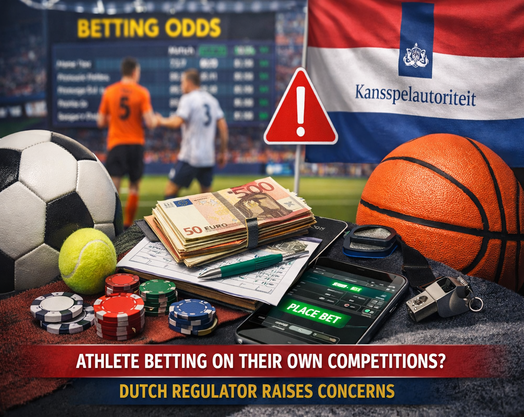
KSA Report Highlights Integrity Concern in Dutch Sports Betting


KSA Report Highlights Integrity Concern in Dutch Sports Betting

A recent review of sports betting integrity reports in the Netherlands has revealed a development that has caught regulators' attention. While the number of suspected match-fixing cases recorded last year remained close to the previous year's total, several reports included a different element: athletes placing wagers on competitions in which they were directly involved.
The findings come from the annual trend analysis conducted by the Dutch gambling authority, the Kansspelautoriteit, which monitors potential manipulation risks in the country's regulated betting market. The report examines alerts submitted by licensed operators and attempts to identify patterns that may require closer attention from both regulators and sports organizations.
 According to the analysis, gambling providers submitted twelve reports of potential match-fixing activity in 2025. The figure shows a slight decline compared with 2024, when 13 cases were recorded. On the surface, the numbers suggest relative stability in the reporting landscape. However, the nature of several reports shifted in a way not seen in previous data.
Four of the alerts filed last year concerned situations in which athletes had placed bets on competitions linked to their own teams or sporting environments. In the year before, no such cases had been recorded. Although the number of reports remains limited, the emergence of this pattern has prompted the regulator to discuss the need for clearer guidance in professional sport.
 Betting by athletes on competitions they participate in is widely regarded as a potential integrity risk. Even if the wagers do not involve attempts to manipulate a result, such actions can create conflicts of interest and undermine trust in sporting contests. For that reason, many leagues and federations restrict or prohibit these types of bets.
The review conducted by the Kansspelautoriteit does not conclude that manipulation occurred in the cases reported. Instead, it identifies the situations as signals that warrant attention. Regulators often treat these reports as early indicators that help them understand how betting activity interacts with the sports sector.
In response to the trend, the authority has increased its focus on preventive education aimed at athletes and sports organizations. The objective is to ensure that individuals involved in professional competitions understand the boundaries that apply when sports betting markets operate alongside their own sporting careers.
 Education programs now emphasize the rules governing betting participation, as well as the risks associated with breaching them. By clarifying expectations, regulators hope to reduce situations in which athletes may unknowingly place bets that raise integrity concerns.
Preventive education has become an important component of the Dutch regulatory framework since the legalization of the country's online gambling market. As sports betting has become more visible, authorities have expanded their communication with clubs, leagues, and athlete associations to explain how the regulatory system works.
At the same time, gambling operators remain responsible for monitoring betting activity on their platforms. Under Dutch law, licensed providers must take steps to identify unusual patterns that could indicate manipulation or other irregular conduct. When such patterns appear, operators are expected to report them to the regulator.
 These reports are sent to the Sports Betting Intelligence Unit, a specialized monitoring body within the regulator. The unit collects data from operators, reviews alerts, and assesses whether further investigation may be necessary. The reporting process has become a central mechanism for the regulator to gather information on potential threats to sports integrity.
 Over the past several years, the authority has encouraged gambling companies to make use of this system more consistently. Increasing awareness among operators has helped establish a more structured channel for communicating suspicious activity.
The regulator has also issued additional guidance to help the industry address match-fixing risks. One of these initiatives is a guideline titled “Commitment to Integrity,” which was published to provide operators with practical tools for identifying and responding to potential manipulation.
The document outlines a range of measures that companies can adopt. These include strengthening internal monitoring procedures, improving staff awareness, and coordinating more closely with sports organizations when unusual betting patterns appear. The aim is to build a network of oversight that extends beyond regulators alone.
Top Online Casinos
10 Recommended Online Brands On CasinoLandia That Will Enhance Your Gaming Experience
No results were found!