





 International
  Argentina
  Australia
  Austria
  Belgium
  Brazil
  Canada
  Chile
Chile  Czechia
  Denmark
  Estonia
  Finland
  France
  Germany
  Greece
  Hungary
  India
India  Indonesia
  Ireland
  Israel
  Italy
Italy  Japan
Japan  Netherlands
  New Zealand
  Nigeria
  Norway
  Malaysia
  Mexico
  Peru
Peru  Philippines
  Poland
  Qatar
Qatar  Romania
  Russia
  Slovakia
  Slovenia
  South Africa
  South Korea
  Spain
Spain  Sweden
  Switzerland
  Thailand
  Turkey
  Vietnam
  UAE
UAE  United Kingdom
  USA
USA - Casino News
- Industry News
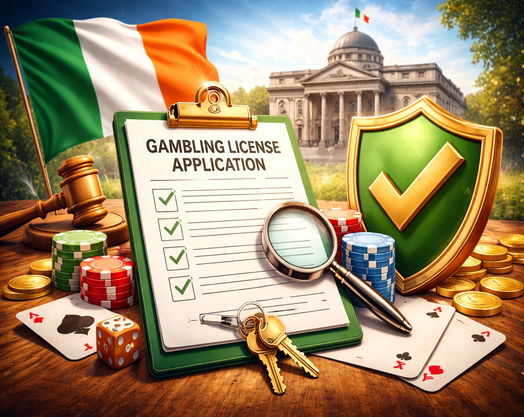
Ireland Opens the Door to a New Gambling Licensing Era


Ireland Opens the Door to a New Gambling Licensing Era

Ireland's gambling market is entering a new regulatory phase as the Gambling Regulatory Authority of Ireland prepares to accept its first licence applications under the country's updated legal framework. From Monday, 9 February, operators seeking approval to offer betting services, both online and in physical locations, will be able to formally apply under the system created by the Gambling Regulation Act 2024.
The opening of the licensing process follows the signing of a commencement order by Minister for Justice, Home Affairs and Migration Jim O'Callaghan TD earlier this week. With that order now in effect, the GRAI moves from a preparatory role into active regulation, supported by statutory powers that extend beyond registration and oversight into enforcement and complaints handling.
 Although the authority has been operational since March 2025, the absence of a live licensing regime has, until now, limited its ability to shape market conduct directly. The launch of licensing is therefore less a procedural update and more a structural shift in how gambling activity will be supervised in Ireland. For the first time, operators will be assessed using a single national framework that applies consistently across all market segments.
Applications will be submitted through a centralised system developed by the GRAI, which will serve as the sole entry point for licensing. The regulator has framed this approach as a way to standardise assessment and ensure that all applicants are evaluated against the same suitability criteria. Ownership structures, funding sources, operational plans, and compliance records will all form part of the review process.
 Rather than opening all licence categories at once, the GRAI has opted for a phased rollout. Different licence types, including those covering remote gambling, land-based betting, and remote betting intermediaries, will be introduced in stages. The authority has indicated that this sequencing is intended to manage application volumes and to allow for detailed scrutiny without unnecessarily delaying decisions.
Financial capacity is expected to be a central consideration during the assessment process. Applicants will need to demonstrate that they can fund the gambling activities they intend to offer and that any winnings paid to customers would come from lawful sources. This requirement reflects the regulator's broader focus on transparency and financial integrity within the market.
For operators seeking licences for physical premises, the process extends beyond corporate documentation. The GRAI will carry out assessments of proposed locations, including reviews of how close venues are to schools and automated teller machines. These checks are intended to align licensing decisions with broader public-interest considerations rather than focusing solely on commercial viability.
 Paul Quinn, Chairperson of the GRAI, described the commencement of licensing as a necessary step in giving effect to the authority's mandate. He said the new powers provide the legal foundation required to regulate the sector in a structured and consistent manner. According to Quinn, transparency and compliance are not supplementary objectives but the basis on which the licensing framework has been constructed.
The authority's Strategy Statement for 2025 to 2027 places particular emphasis on proportionality and efficiency. Licensing is positioned as a tool that should support orderly market participation while enabling the regulator to intervene where standards are not met. In this context, the framework is intended to balance regulatory oversight with predictability for operators.
Chief Executive Officer Anne Marie Caulfield has also pointed to the licensing launch as a defining moment for the organisation. She credited the preparatory work carried out by the GRAI's licensing and ICT teams, noting that the system's structure reflects extensive planning rather than a rapid rollout. The regulator has spent the past year building processes designed to assess applications in depth rather than relying on surface-level checks.
 Caulfield noted that licensing under the new regime is intended to be selective. The aim, she said, is not to maximise the number of licensed operators but to ensure that those granted approval meet the standards set out in law. In her view, this approach supports the broader objective of reducing harm and improving accountability across the sector.
The regulator has encouraged operators to engage with the process early, particularly given the requirement to publish a Notice of Intention at least 28 days before submitting an application. This step, introduced during earlier consultations, is designed to increase transparency and allow for preliminary scrutiny before formal assessments begin.
 Those consultations took place last year, when the GRAI invited prospective licensees to submit expressions of interest. Feedback gathered during that period informed the design of the licensing framework now coming into force. While the consultation phase did not involve formal approvals, it provided the regulator with insight into market readiness and operational expectations.
The Gambling Regulation Act 2024 was introduced to replace a fragmented regulatory landscape that had developed over decades. Under the new model, the GRAI serves as a single authority with responsibility for licensing, compliance monitoring, enforcement, and complaint resolution across all forms of regulated gambling activity.
As applications begin to be submitted, attention is likely to turn to how the system operates in practice. Processing timelines, decision-making consistency, and the regulator's capacity to handle demand will shape early perceptions of the framework. For operators, the coming months will offer the first indication of how Ireland's reformed approach to gambling regulation will function on the ground.
Top Online Casinos On Our Land
10 Recommended Online Brands On CasinoLandia That Will Enhance Your Gaming Experience
No results were found!