






 International
  Argentina
  Australia
  Austria
  Belgium
  Brazil
  Canada
  Chile
Chile  Czechia
  Denmark
  Estonia
  Finland
  France
  Germany
  Greece
  Hungary
  India
India  Indonesia
  Ireland
  Israel
  Italy
Italy  Japan
Japan  Netherlands
  New Zealand
  Nigeria
  Norway
  Malaysia
  Mexico
  Peru
Peru  Philippines
  Poland
  Qatar
Qatar  Romania
  Russia
  Slovakia
  Slovenia
  South Africa
  South Korea
  Spain
Spain  Sweden
  Switzerland
  Thailand
  Turkey
  Vietnam
  UAE
UAE  United Kingdom
  USA
USA - Casino News
- Industry News
- Sports Betting
France Tests a New Legal Path for Blockchain-Based Games


France Tests a New Legal Path for Blockchain-Based Games

France has taken a formal step into the regulatory grey area where video games, digital assets, and gambling mechanics intersect. Through a newly activated framework, the country has begun supervising titles that rely on monetisable digital objects, establishing a structure that neither treats them as conventional gambling nor leaves them outside regulatory reach.
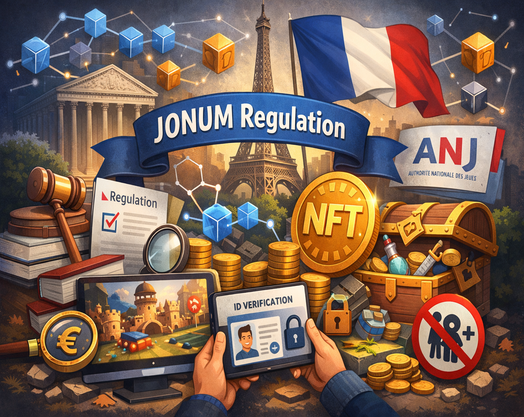
The initiative has been implemented by the Autorité Nationale des Jeux, which will oversee the regime over an initial three-year period. Known as Jeux à Objets Numériques Monétisables (JONUM), the system applies to games that incorporate elements of chance and financial commitment, and that distribute digital assets that can later be traded. These assets may include blockchain-based tokens or NFTs, provided they do not result in direct cash payouts from the operator.
 The framework originates from the Security and Digital Space Regulation Act, adopted in May 2024. That legislation introduced a distinct legal category for online titles built around chance-based mechanics and resellable digital objects. With the publication of implementing decrees, the framework has now moved from legislative concept to operational reality.
At its core, JONUM addresses a structural gap. Traditional gambling law in France applies to products where players stake money in exchange for the possibility of receiving monetary prizes. By contrast, many blockchain-linked games offer digital items instead of cash. While these items can hold market value through resale, they do not constitute direct payouts. This distinction has complicated classification efforts across Europe, prompting varying responses from national authorities.
 Under the French model, games falling within the JONUM category are prohibited from awarding cash prizes in legal tender. Operators must ensure that any value generated remains confined to digital objects whose resale potential depends on external market conditions. In doing so, the framework separates these products from licensed gambling offerings while acknowledging their economic dimension.
The regulator has also introduced quantitative limits. A cap applies to the cumulative value of digital assets that a single user may obtain over time. This restriction is designed to prevent excessive accumulation and reduce financial exposure from speculative trading of in-game items. It signals that although the regime does not equate these products with gambling in the traditional sense, it recognises the financial implications embedded in tradable digital goods.
 Participation by minors is strictly prohibited. Operators are required to verify age and identity at the point of account creation, aligning oversight standards with those imposed on licensed gambling providers. Responsible participation tools must also be integrated into game design. Time limits, spending controls, and self-exclusion mechanisms are mandatory, reinforcing the view that behavioural risk management remains relevant even when prizes are non-monetary.
Compliance obligations extend beyond player-facing safeguards. Any operator intending to make a JONUM product available in France must submit a declaration to the ANJ and maintain detailed operational records. Where blockchain infrastructure or digital wallets are involved, the regulator must be able to trace transaction flows. This access is intended to support anti-money laundering monitoring and broader financial compliance.
 The inclusion of blockchain transparency requirements reflects the regulator’s awareness that decentralised systems do not operate outside legal accountability. While distributed ledgers provide technical traceability, effective supervision depends on structured reporting and data accessibility. By embedding these conditions into the framework, the ANJ has positioned itself to monitor both game mechanics and asset circulation.
 France’s decision to create a dedicated regime contrasts with other European approaches. In Belgium, authorities have interpreted certain loot box systems as gambling and moved toward prohibition. In the United Kingdom, policymakers concluded that loot boxes fall outside the scope of the Gambling Act 2005 and instead encouraged industry-led standards through bodies such as Ukie. France’s route sits between these positions, opting neither for a blanket ban nor for reliance on voluntary codes alone.
The three-year pilot structure leaves room for adjustment. During this period, the ANJ will be able to collect data on operator compliance, user participation patterns, and the financial dynamics of digital asset trading within regulated titles. The temporary nature of the framework suggests that lawmakers view this as a testing phase rather than a final settlement of the issue.
Top Online Casinos On Our Land
10 Renowned Online Casinos On CasinoLandia That Will Cater For Your Casino Needs
No results were found!