





 International
  Argentina
  Australia
  Austria
  Belgium
  Brazil
  Canada
  Chile
Chile  Czechia
  Denmark
  Estonia
  Finland
  France
  Germany
  Greece
  Hungary
  India
India  Indonesia
  Ireland
  Israel
  Italy
Italy  Japan
Japan  Netherlands
  New Zealand
  Nigeria
  Norway
  Malaysia
  Mexico
  Peru
Peru  Philippines
  Poland
  Qatar
Qatar  Romania
  Russia
  Slovakia
  Slovenia
  South Africa
  South Korea
  Spain
Spain  Sweden
  Switzerland
  Thailand
  Turkey
  Vietnam
  UAE
UAE  United Kingdom
  USA
USA - Casino News
- Industry News
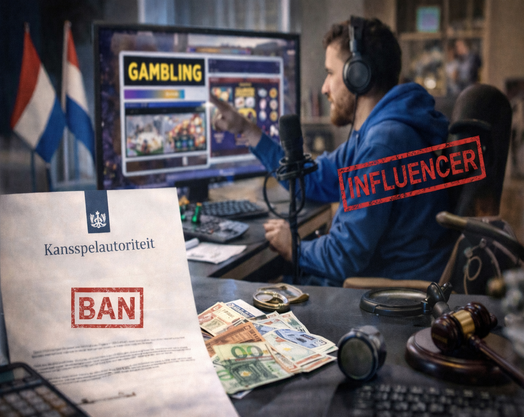
Dutch Influencers Explicitly Barred from Gambling Promotion


Dutch Influencers Explicitly Barred from Gambling Promotion
When the Netherlands introduced restrictions on the use of role models in gambling advertising, the objective appeared straightforward: reduce the appeal of gambling among vulnerable groups. Yet as marketing channels evolved, one question persisted within the industry. Did the ban apply only to traditional celebrities, or did it also cover the growing class of online personalities who build audiences through social media platforms? The Dutch regulator has now answered that question directly.
The Kansspelautoriteit has informed online licence holders that influencers, streamers, vloggers, and similar digital figures fall within the scope of the role model prohibition. In the regulator's interpretation, the decisive factor is not formal celebrity status but the ability to attract identification from followers, particularly minors and young adults.
 The clarification was delivered in a letter to licensed operators following the authority's observation of market uncertainty. Some providers had questioned whether collaborations with online creators were permissible, especially where those individuals were not nationally known public figures. The KSA's response leaves little room for ambiguity. If a person's public profile is sufficiently visible to make them commercially valuable for recruitment or branding purposes, they may not be used to promote online games of chance.
The role model ban was introduced as part of a broader effort to strengthen consumer protection in the Dutch gambling market following its 2021 regulation. Policymakers were concerned that promotional campaigns could influence young adults who are statistically more prone to risk-taking behaviour. By excluding figures who function as aspirational examples, the government sought to reduce the persuasive power of gambling advertising.
 In its latest communication, the regulator emphasised that identification is central to its assessment. Influencers and streamers often cultivate a relationship of familiarity with their audience. Followers may perceive them not as distant celebrities but as relatable personalities. According to the KSA, this perceived proximity increases the likelihood that promotional messages delivered through such figures carry behavioural weight.
For operators, the implications are immediate. Existing agreements with influencers must be reviewed and, where necessary, terminated. The regulator has urged companies to end non-compliant collaborations without delay. The instruction does not distinguish between influencers with millions of followers and those with more targeted audiences. The determining factor is whether the individual's visibility and reach make them a suitable marketing vehicle.
 The KSA's interpretation reflects a broader recognition that influence has shifted from traditional media to digital platforms. Advertising strategies that once revolved around television personalities or professional athletes now often centre on social media creators whose authority stems from perceived authenticity. By extending the role model definition to include these figures, the regulator aligns its framework with contemporary marketing realities.
This development comes amid renewed debate over public perceptions of gambling in the Netherlands. Recent survey data cited by the regulator indicate that 24 per cent of respondents believe gambling is viewed as normal behaviour within their social circle. The findings do not isolate advertising as the sole cause of such perceptions, but they contribute to the regulatory concern that gambling is increasingly framed as an ordinary, routine activity.
 The survey also revealed a gender disparity. Thirty-two per cent of male respondents reported that gambling is considered normal among their peers, compared with 16 per cent of female respondents. In addition, 18 per cent of those surveyed said they frequently hear that gambling represents a convenient way to generate money quickly. For the regulator, such attitudes underscore the need to limit promotional narratives that could reinforce optimistic assumptions about financial gain.
While the KSA's letter does not introduce new legislation, it sharpens the interpretation of existing rules. In practical terms, this reduces room for differing readings of the law. Operators can no longer argue that influencer marketing falls outside the prohibition's intended scope. The guidance effectively establishes a uniform compliance expectation across the market.
 The Dutch gambling sector has already undergone several regulatory adjustments since legalisation. Restrictions on untargeted advertising and sports sponsorship have been phased in, and political discussions continue regarding the appropriate balance between channelisation, consumer protection, and commercial freedom. The clarification on influencers forms part of this incremental tightening of promotional standards.
From a policy perspective, the regulator's approach suggests a preventative logic. Rather than waiting for evidence of direct harm linked to specific campaigns, the authority is acting on the assumption that visibility and identification create risk, particularly among younger audiences. By removing influencer-led promotion from the permissible toolkit, the KSA aims to reduce that risk at its source.
For marketing departments within licensed operators, the shift requires recalibration. Digital outreach strategies must now rely on formats that do not involve public personalities who could be perceived as role models. This may lead to greater emphasis on informational advertising or on channels that enable more stringent audience segmentation.
Top MGA Online Casinos
10 Recommended MGA Online Brands On CasinoLandia That Will Enhance Your Gaming Experience
No results were found!