





 International
  Argentina
  Australia
  Austria
  Belgium
  Brazil
  Canada
  Chile
Chile  Czechia
  Denmark
  Estonia
  Finland
  France
  Germany
  Greece
  Hungary
  India
India  Indonesia
  Ireland
  Israel
  Italy
Italy  Japan
Japan  Netherlands
  New Zealand
  Nigeria
  Norway
  Malaysia
  Mexico
  Peru
Peru  Philippines
  Poland
  Qatar
Qatar  Romania
  Russia
  Slovakia
  Slovenia
  South Africa
  South Korea
  Spain
Spain  Sweden
  Switzerland
  Thailand
  Turkey
  Vietnam
  UAE
UAE  United Kingdom
  USA
USA - Casino News
- Industry News
- Sports Betting
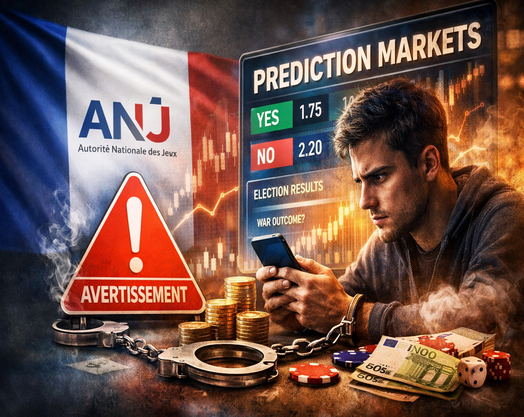
ANJ Examines the Risks Behind Prediction Markets


ANJ Examines the Risks Behind Prediction Markets

As prediction market platforms expand beyond their initial growth markets, French authorities have begun to draw clearer lines around how such services fit within national gambling law. The Autorité Nationale des Jeux has issued a warning highlighting what it considers structural and behavioural risks associated with these platforms, pointing in particular to their framing as investment tools rather than betting products.
Prediction markets allow users to buy and sell contracts tied to the outcome of future events. These events may range from election results to sports fixtures or geopolitical developments. Participants effectively stake money on whether a particular scenario will occur, with contract prices fluctuating according to perceived probability. While the model presents itself as a form of forecasting or information aggregation, the ANJ considers that, in practice, it closely resembles gambling activity.
 The regulator’s latest communication focuses on two parallel concerns. The first relates to user behaviour. The second addresses the broader consequences that may arise when financial incentives intersect with real-world events.
According to the ANJ, prediction market platforms are reaching a segment of the public that has not traditionally engaged with licensed casinos or sports betting operators. By describing contracts as investment opportunities, these platforms may attract individuals who see themselves as traders rather than gamblers. This distinction, the authority argues, can influence how risk is perceived and managed.
The regulator cautions that the investment framing may contribute to what it calls an “illusion of competence.” When outcomes are presented as matters of analysis or informed judgment, users may believe that research or personal insight gives them a measurable advantage. In this environment, participation can increase as confidence grows. The perception of control may encourage repeated activity, reinforcing patterns that resemble problematic gambling behaviour.
 In the regulator’s view, media narratives have reinforced this perception. Coverage of large gains, often compared to cryptocurrency trading, can create an impression that profits are accessible to those who interpret events correctly. The ANJ notes that such representations may obscure the underlying uncertainty that defines these contracts. While prediction markets rely on probability assessments, outcomes remain contingent and often influenced by factors beyond any individual’s knowledge.
A second area of concern relates to consumer protection. In France, licensed gambling operators must comply with a series of obligations, including age verification, deposit limits, and session controls. These safeguards are designed to reduce excessive play and limit access by minors. The ANJ has stated that many prediction market platforms operate without equivalent mechanisms when accessed from jurisdictions where they are not authorised.
 This regulatory gap, the authority suggests, creates uneven conditions between licensed gambling operators and prediction platforms that present similar financial risks. Where traditional betting sites are subject to supervision and enforcement, prediction markets may function outside that perimeter while still offering contracts tied to uncertain events.
Beyond individual behaviour, the ANJ has also addressed potential systemic risks. It warns that when participants cannot only wager on an event but also influence its likelihood, financial incentives can spill over into the real world. In the context of sport, this could mean attempts to affect performance outcomes. In political or geopolitical contexts, it raises the possibility that individuals might seek to accelerate or manipulate events in which they hold a financial stake.
Such concerns reflect a broader debate about the intersection of speculation and accountability. Prediction markets often argue that they aggregate public sentiment and provide insight into collective expectations. Regulators, however, question whether these benefits offset the potential for conflict of interest when money is directly linked to uncertain or sensitive outcomes.
 The ANJ’s warning follows earlier contact with Polymarket, one of the most visible platforms operating in the sector. After discussions with the French authority, the platform restricted access for users located in France. The regulator indicated that the service was likely offering unauthorised gambling under national law. Despite this step, the ANJ has signalled that it remains attentive to the possibility that similar operators may continue to target French customers.
The issue is not confined to France. In the United Kingdom, the Gambling Commission has clarified that it considers prediction markets offering event-based contracts to UK consumers to fall within the scope of gambling legislation and require an appropriate licence. In the Netherlands, the Kansspelautoriteit has also warned that unlicensed activity in this space could lead to enforcement measures.
These parallel positions suggest that European regulators are converging on a similar interpretation: when users stake money on uncertain outcomes with the prospect of financial return, the activity may warrant classification as gambling, regardless of how it is marketed.
Top Online Casinos On Our Land
10 Renowned Online Casinos On CasinoLandia That Will Cater For Your Casino Needs
No results were found!