





 International
  Argentina
  Australia
  Austria
  Belgium
  Brazil
  Canada
  Chile
Chile  Czechia
  Denmark
  Estonia
  Finland
  France
  Germany
  Greece
  Hungary
  India
India  Indonesia
  Ireland
  Israel
  Italy
Italy  Japan
Japan  Netherlands
  New Zealand
  Nigeria
  Norway
  Malaysia
  Mexico
  Peru
Peru  Philippines
  Poland
  Qatar
Qatar  Romania
  Russia
  Slovakia
  Slovenia
  South Africa
  South Korea
  Spain
Spain  Sweden
  Switzerland
  Thailand
  Turkey
  Vietnam
  UAE
UAE  United Kingdom
  USA
USA - Casino News
- Industry News
Estonia Revisits Gambling Tax Law After Drafting Slip


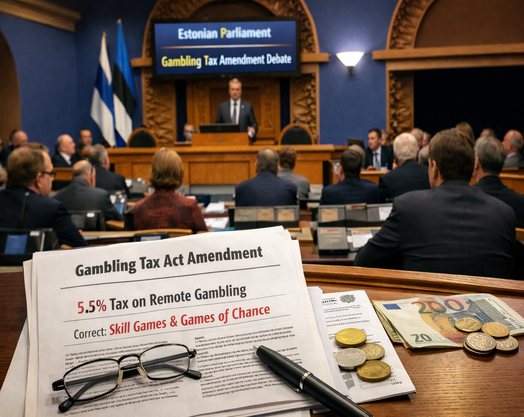
Estonia Revisits Gambling Tax Law After Drafting Slip

A technical error in legislative wording has prompted Estonia’s parliament to revisit its Gambling Tax Act, after an unintended omission left online casino operations outside the scope of this year’s revised tax rate. Lawmakers are now preparing to correct the text and restore the originally intended 5.5 per cent levy on remote gambling, with the amendment scheduled to take effect on March 1, 2026.
The situation emerged from changes adopted late last year as part of a broader plan to reduce gambling tax gradually. Estonia had set out a multi-year adjustment, lowering the rate from 6 per cent to 4 per cent by 2028, cutting it by half a percentage point each year. For 2026, the rate was meant to stand at 5.5 per cent.
 However, when the revised provisions were drafted, the clause applying the 5.5 per cent rate referred only to “skill games” as defined in the relevant section of the law. The category “games of chance,” under which online casino activities fall, was not included in the operative wording for the current year. In contrast, the language covering subsequent years correctly referred to both categories.
The omission was not identified immediately. It was only after the law entered into force that the discrepancy became clear. By excluding games of chance from the applicable clause, the text effectively removed the legal basis for taxing online casino operations at the intended rate.
The discovery created an unusual situation. Operators remained subject to regulatory oversight, yet the statutory basis for collecting the revised tax on online casino activity remained unclear. Industry representatives indicated a willingness to continue paying in line with the policy’s original intent. Companies such as Yolo Group, along with the national gambling operators’ association, signaled that maintaining contributions would support stability.
 The Ministry of Finance, however, took a cautious position. Officials noted that payments made without an explicit legal obligation could not formally be recognized as tax revenue. Estonia’s fiscal framework requires a clear statutory basis for the collection and accounting of taxes. Accepting voluntary transfers in place of a defined levy would introduce legal and administrative uncertainty.
Member of Parliament Tanel Tein introduced an amendment designed to resolve the issue. He acknowledged that the discrepancy stemmed from drafting rather than policy change and emphasized the need for a prompt correction. The proposal reinstates “games of chance” within the relevant clause, thereby restoring the intended scope of the 5.5 per cent rate for remote gambling.
 Parliament is expected to vote on the amendment before the end of February. The proposed implementation date of March 1 has been selected to coincide with the monthly tax cycle. According to government statements, aligning the correction with the start of a new reporting period will reduce disruption for both operators and tax authorities.
Remote gambling forms a meaningful part of Estonia’s regulated betting market. The 5.5 per cent levy on remote gambling is forecast to generate approximately €27 million in 2026. While operators expressed readiness to comply with the intended rate, the absence of clear wording raised concerns about how such payments would be treated under public finance rules.
 The episode illustrates how technical drafting choices can carry financial consequences. In regulatory frameworks where definitions determine tax obligations, the distinction between categories such as skill games and games of chance is not semantic. It defines the taxable base.
Estonia’s phased reduction of gambling tax has been positioned as a long-term measure aimed at balancing competitiveness with fiscal responsibility. The annual half-percentage-point decrease was structured to provide predictability for licensed operators while maintaining public revenue. Ensuring that legislative language reflects that structure is central to its implementation.
The amendment does not alter the broader policy trajectory. It restores the alignment between stated intent and statutory wording. Future-year provisions remain unchanged, and the schedule for gradual reduction toward 4 per cent by 2028 continues as planned.
Top Online Casinos
10 Recommended MGA Online Brands On CasinoLandia That Will Enhance Your Gaming Experience
No results were found!